







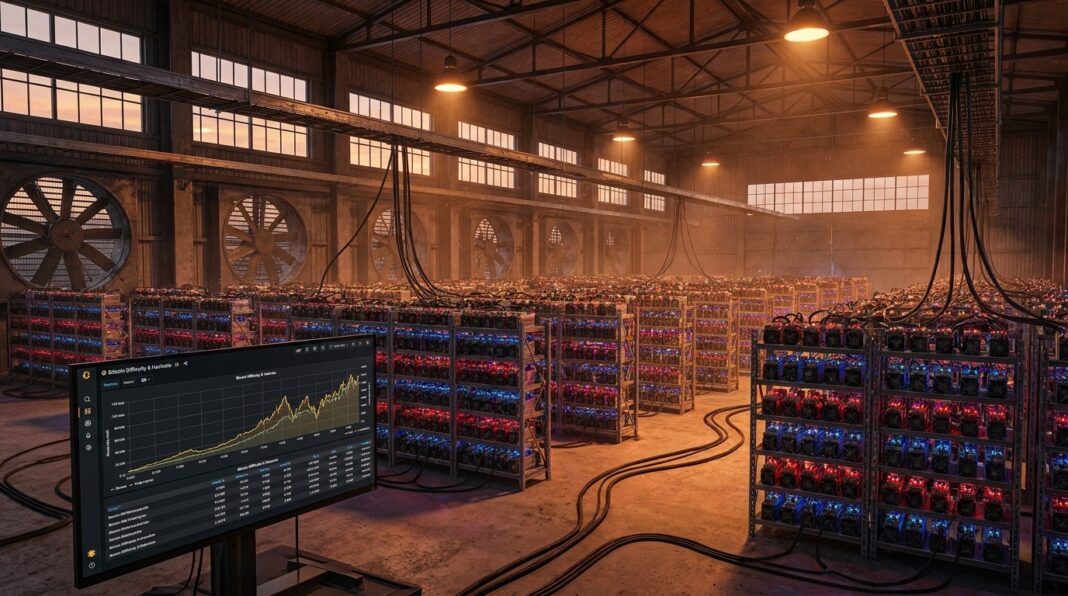

Bitcoin mining difficulty falls 14% from this year’s high, with the current difficulty measured at 126.23 trillion after a 0.74% adjustment lower. The all-time high reached 155.97 trillion in November 2025, which is about 19.1% above the present level; the difficulty is roughly 1.1% below the 127.62 trillion reported a year ago. The 14% reduction reflects a drop from the January peak earlier this year.
Bitcoin mining difficulty stands at 126.23 trillion following a 0.74% reduction at the most recent adjustment. That current reading represents roughly a 14% decline from the peak level observed in January 2026 and is presented here alongside the all-time high of 155.97 trillion recorded in November 2025. The November 2025 peak is approximately 19.1% higher than the present difficulty level.
Protocol rules require difficulty to be recalculated every 2,016 blocks, which is roughly every two weeks, and those scheduled adjustments are intended to keep the network’s average block time near 10 minutes. The periodic recalculation is the mechanism that sets the numeric difficulty used by miners at each adjustment point. Maintaining the target block interval through these adjustments is the stated significance of the difficulty metric and its regular updates.
Hashprice, which measures expected miner revenue for each unit of computing power, fell to $27.66 per petahash per day in late June and was within one cent of its February low. Hashprice has since risen to $31.7 per petahash per day. These movements represent recent volatility in expected miner revenue per unit of hashing power.
Luxor’s forward market prices an average hashprice of $31.85 per petahash per day through December. That forward level is only modestly above recent spot levels. That modest spread in forward pricing is presented alongside the spot changes noted above.
Taken together, the reported fall to $27.66, the rebound to $31.7 and Luxor’s forward average at $31.85 are cited in the source as indicators of constrained miner revenue prospects. The source states that the forward level is only modestly above recent spot levels and suggests little revenue recovery for the remainder of 2026.
Luxor’s Hashrate Index attributed the recent decline in Bitcoin mining difficulty to falling bitcoin prices, compressed mining revenue and the diversion of capital, power and operators toward AI and high-performance computing infrastructure. The Index stated that this episode is more mining economics-based. The report also places the current decline in historical perspective by noting that the only previous year-over-year drop in difficulty occurred after China’s 2021 mining ban.
These reported explanations and the cited historical precedent are presented together in the article. They are offered as context for the observed reduction in mining difficulty.
In 2026, reporting shows that Bitcoin mining difficulty has eased while miner revenue indicators declined and later showed a partial rebound, and forward pricing remains only modestly above recent spot levels. The analysis links these developments to technical and economic mining factors and frames a cautious market outlook for miners and revenues for the remainder of the year.