







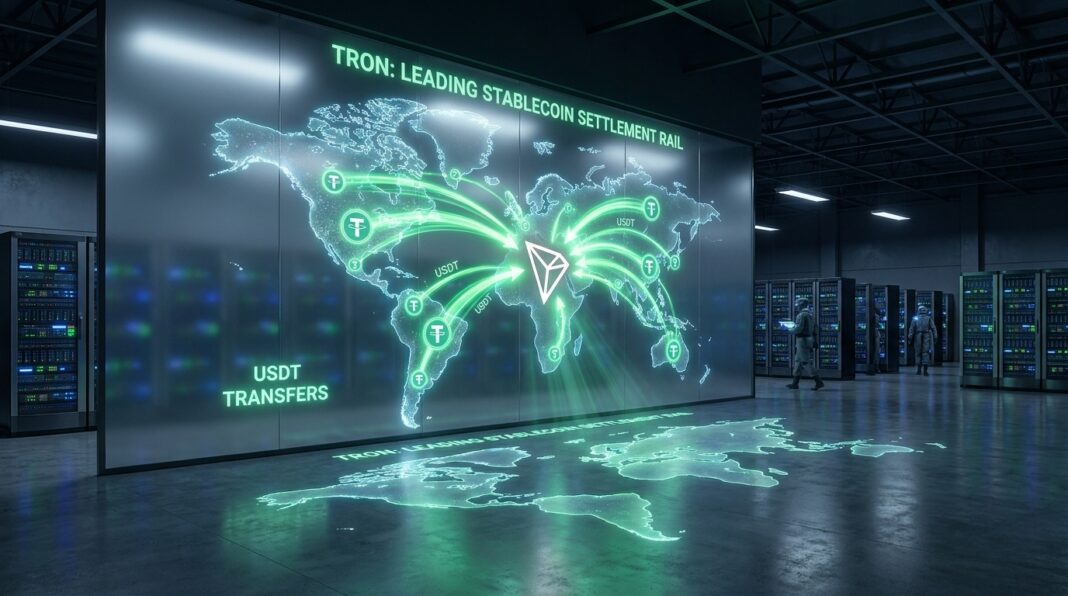

Tron is the leading settlement rail for stablecoins, particularly USDT, notably settling roughly $150 billion of stablecoins per week. Weekly transaction counts on Tron have climbed to nearly 100 million, and average on-chain fees have fallen to about seven cents, a multiyear low. The layer‑1 blockchain operates a delegated proof‑of‑stake consensus with 27 Super Representatives, processes billions of dollars in value transfers every day, and serves as global payment infrastructure.
Tron is a layer-1 blockchain that employs a delegated proof-of-stake (DPoS) consensus mechanism with 27 Super Representatives constituting its representative layer. The DPoS structure and the set of 27 Super Representatives are core components of Tron’s consensus arrangement. Those governance roles are embedded in the network’s protocol and define how blocks are proposed and validated. The combination of a layer‑1 architecture and DPoS is part of Tron’s stated technical foundation.
Tron launched in 2018 as an ERC‑20 token on Ethereum before migrating to its own blockchain. The project was initially conceived as a content‑distribution project. Over time its orientation shifted toward serving as global payment infrastructure. The migration from an Ethereum token standard to an independent blockchain coincided with that evolution in focus.
Tron plays a crucial role as the leading settlement network for stablecoins, with a significant focus on the USDT. A substantial portion of the global circulation of USDT now resides on the Tron network, highlighting its prominence in the stablecoin market. Tron handles a massive scale of stablecoin transfers, with weekly volumes ranging from $150 billion to $190 billion. This is indicative of its capacity to process large financial transactions efficiently. Furthermore, Tron’s network supports nearly 100 million transactions weekly and manages daily transfers amounting to billions of dollars. These metrics underscore Tron’s position as a pivotal player in the global digital payment infrastructure, facilitating high-volume stablecoin transactions with remarkable efficiency.
The average on-chain transaction fee on Tron is around seven cents, a level identified as a multiyear low in the reporting. The TRX token price is cited at approximately $0.3396.
“The views expressed in this column are those of the author and do not necessarily reflect those of CoinDesk, Inc., CoinDesk Indices or its owners and affiliates.”
These numeric items are stated plainly.
Tron remains an essential settlement network for stablecoins, serving as a primary rail for large-scale transfers and settlements. The network is characterized by high transaction volumes and comparatively low on‑chain fees that support frequent settlement activity and rapid value transfers. These operational attributes underpin Tron’s role in facilitating extensive stablecoin movement across markets.