







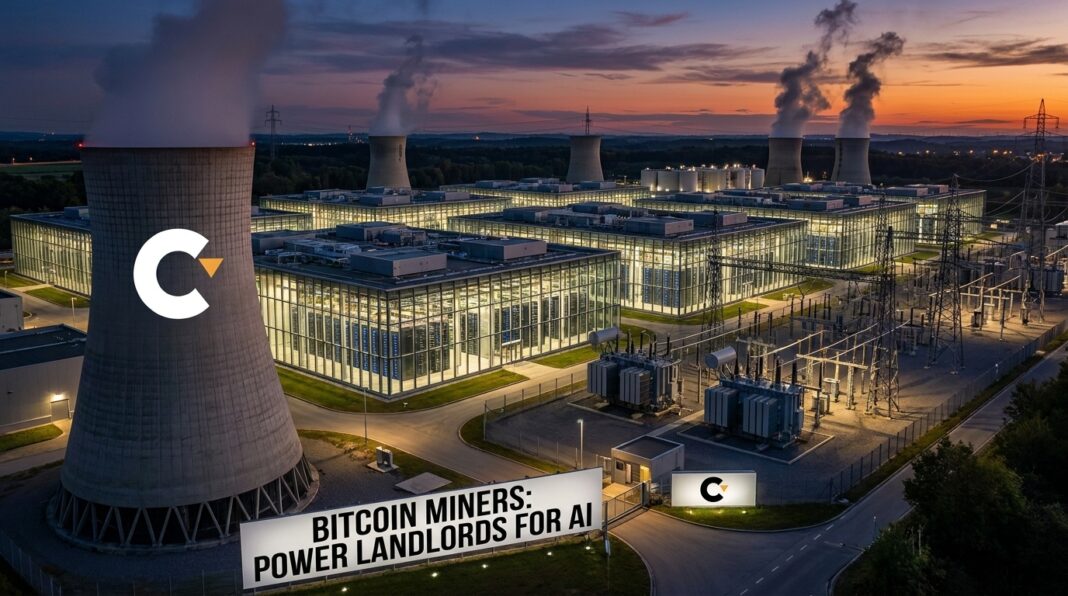

Bitcoin miners as power landlords for AI are emerging in the AI boom, visible in recent large-scale commercial agreements. Over the past two years they have reached 17 deals worth more than $110 billion. Those deals include roughly 6 gigawatts of power contracted to Google, Amazon, Microsoft, Nvidia and CoreWeave, and miners have plans for a 30-gigawatt power portfolio overall.
Miners have contracted roughly 6 gigawatts of power to Google, Amazon, Microsoft, Nvidia and CoreWeave. Those contracted capacities are tied to the five named companies and are described as roughly 6 gigawatts in aggregate. The reporting states that this scale accounts for about 10% of all AI data centers currently under construction in the United States.
The colocation model used involves long-term, take-or-pay contracts for power supply. The description identifies these agreements specifically as long-term, take-or-pay contracts. The reporting also mentions “warm powered shells,” defined as facilities with electricity already flowing and ready for computing hardware to move in. Both the colocation model with long-term, take-or-pay contracts and the use of warm powered shells are cited as elements of the miners’ infrastructure arrangements.
The AI revenue for companies involved in the Bitcoin mining sector is projected to increase significantly, from $1.2 billion this year to $10.7 billion by 2030. Specific projections for TeraWulf and Cipher Digital indicate substantial growth in their AI-related revenues. TeraWulf is expected to see AI revenues reach $1.7 billion by 2030, with EBITDA margins approaching 84%. Meanwhile, Cipher Digital is projected to achieve $1.2 billion in AI revenue by 2030, with margins nearing 93%. Both companies have seen impressive stock performance in 2026, with TeraWulf’s shares rising nearly 122%, and Cipher Digital’s shares increasing by about 69% during the same period. These projections reflect significant financial potential within the Bitcoin mining landscape.
Project financing markets are covering 75–85% of construction costs for AI-related infrastructure built by Bitcoin miners. Reported conditions show interest rates in project financing are below the returns generated by the related contracts. That financing structure is presented as supporting the colocation model of long-term, take-or-pay contracts for power supply used by miners.
The linkage between project financing and the colocation take-or-pay contracts is explicitly stated. Bernstein and Société Générale are named as related entities in the reporting.
Bitcoin miners are emerging as “Power Landlords” in the AI boom, shifting from traditional mining operations toward managing large-scale power portfolios that support AI compute deployments. They have established strategic contracts with major technology firms and are using colocation arrangements and ready-to-power facilities to host computing hardware.
These developments are paired with substantial financial projections and marked market activity described in the reporting. The reporting frames miners as significant infrastructure players in the AI market, positioned to supply both energy and prepared facilities for AI data center growth.