






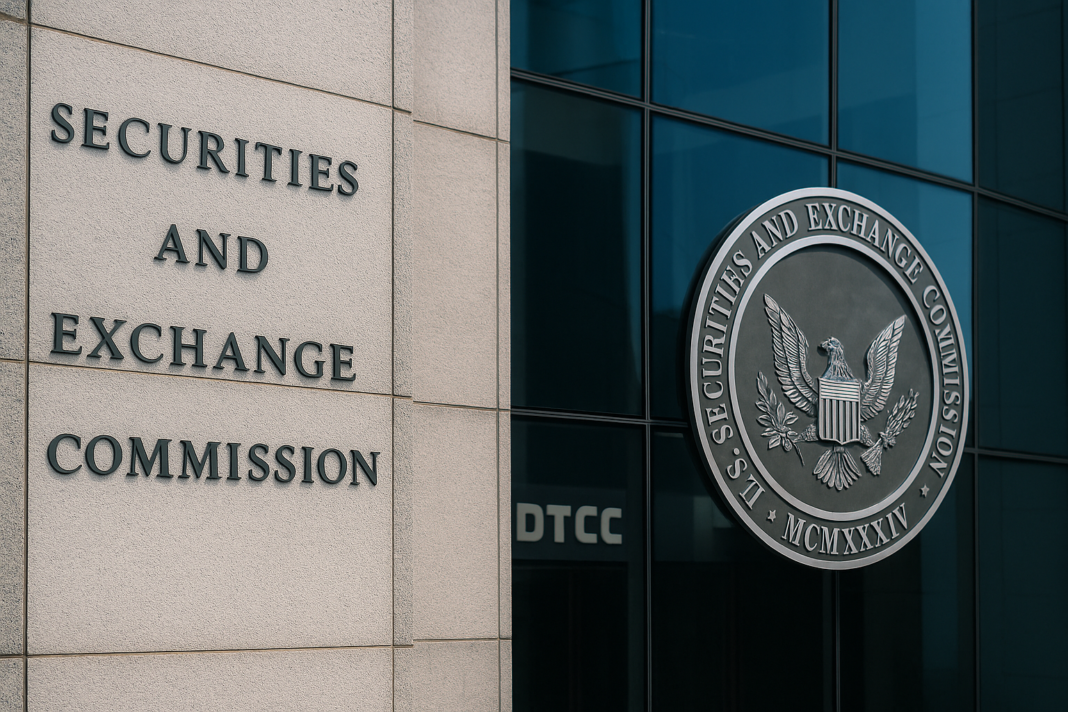

The U.S. Securities and Exchange Commission has taken a historic step toward integrating blockchain technology with traditional finance by granting the Depository Trust Company (DTC), a subsidiary of DTCC, approval to launch a tokenization service for assets held in its custody.
The SEC’s No-Action Letter
The SEC issued a three-year no-action letter to DTC, providing regulatory clarity for a controlled-production tokenization program. This approval allows DTCC to tokenize traditional financial assets on approved blockchain networks while maintaining the same legal rights and protections as their conventional counterparts.
The program is scheduled to begin rolling out in the second half of 2026, giving market participants time to prepare for this transformative shift in how securities are recorded and transferred.
What Is DTCC?
For those unfamiliar with traditional finance infrastructure, DTCC (Depository Trust & Clearing Corporation) is the backbone of the U.S. securities market. It processes virtually all equity and fixed-income securities transactions in the United States—handling over 2 billion securities transactions annually worth more than $2 quadrillion.
Through its subsidiary DTC, DTCC provides custody and asset servicing for over 1.3 million active securities issues. Bringing tokenization to this level of the financial system represents a seismic shift in market infrastructure.
How the Tokenization Will Work
Under the approved framework:
- Asset Coverage: Traditional securities held in DTC custody can be tokenized
- Blockchain Networks: Tokenization will occur on approved Layer-1 and Layer-2 networks
- Legal Equivalence: Digital versions will maintain the same rights and protections as physical securities
- Regulatory Oversight: Operations will remain under SEC supervision throughout the three-year pilot
- Controlled Rollout: Gradual implementation beginning in H2 2026
Why This Matters
This approval represents a watershed moment for several reasons:
1. Regulatory Clarity: For years, the crypto industry has struggled with regulatory uncertainty. The SEC’s explicit approval of tokenization for traditional assets provides a clear framework that other institutions can follow.
2. Institutional Validation: When the organization that settles virtually all U.S. securities transactions adopts blockchain technology, it sends a powerful signal about the technology’s maturity and viability.
3. Efficiency Gains: Tokenization can dramatically reduce settlement times, lower operational costs, and improve transparency in securities markets.
4. 24/7 Markets: Unlike traditional markets that close, tokenized assets could potentially be traded around the clock, improving liquidity and market access.
5. Fractional Ownership: Tokenization makes it easier to divide expensive assets into smaller units, democratizing access to investments previously available only to wealthy individuals or institutions.
Looking Ahead
The SEC’s approval of DTCC’s tokenization program represents more than just a technical upgrade—it’s a signal that regulators are willing to embrace blockchain technology when implemented within proper guardrails.
As the 2026 launch approaches, expect to see increased investment in tokenization infrastructure, more financial institutions announcing blockchain initiatives, development of new financial products leveraging tokenized assets, and potential international coordination on tokenization standards.
For the crypto industry, this approval vindicates years of advocacy for blockchain’s potential to transform traditional finance. For traditional finance, it opens the door to efficiency gains and new capabilities that could reshape markets for decades to come.
The convergence of TradFi and DeFi is no longer a distant possibility—it’s becoming reality, with DTCC leading the charge.