







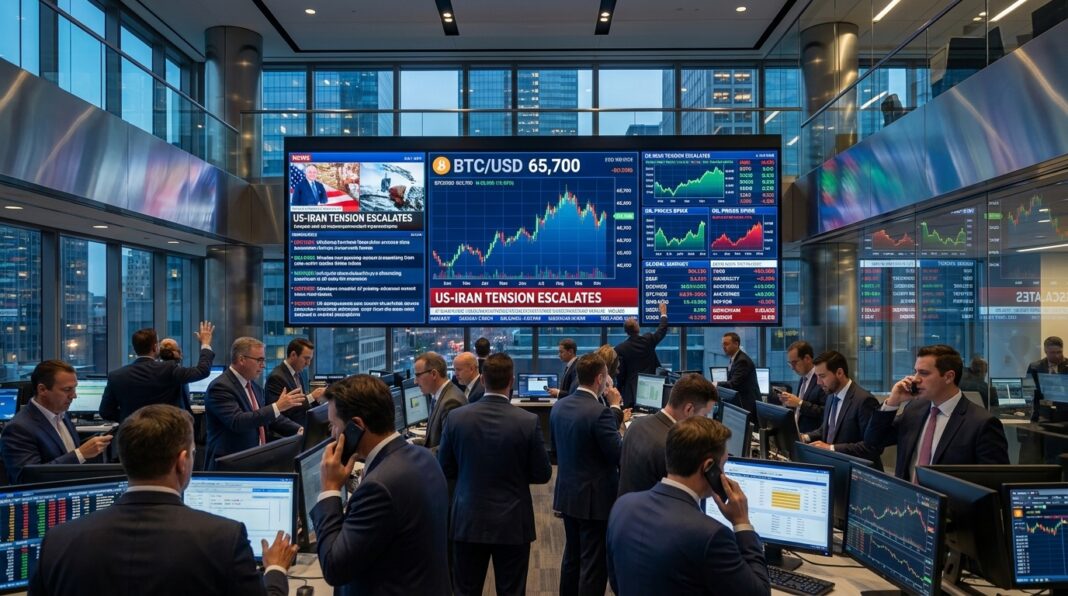

Bitcoin saw a rise above $65,700 as geopolitical tensions between the United States and Iran heightened. Amid threats of military strikes, the cryptocurrency surged to $65,810, marking an increase of 2.2% from the previous day.
Additionally, international efforts have led to the extension of the US-Iran ceasefire and the reopening of the Strait of Hormuz, a key passageway for global energy trade. This extension aims to de-escalate a prolonged conflict that has affected global markets, though the future remains uncertain due to recent military actions in the region.
The United States and Iran have reached a tentative peace agreement with a formal signing scheduled for June 19, 2026, in Geneva, Switzerland. Learn More
Threats of military strikes on Iran’s energy infrastructure have been a market concern during the conflict, as energy markets prepared for possible U.S. attacks. Learn More
The interim deal is reported to include reopening the Strait of Hormuz and extending a ceasefire. Learn More
The Strait of Hormuz is a critical global energy shipping route that previously carried roughly one-fifth of the world’s oil and liquefied natural gas. Learn More
Announcement of the deal coincided with a drop in crude oil prices, with Brent crude falling more than 4% to about $84.21 per barrel. Learn More
Energy experts cautioned that oil and gas supplies could take several months to return to normal because of logistical and production disruptions caused by the conflict. Learn More
The U.S. core Personal Consumption Expenditures (PCE) price index rose 3.2% year‑over‑year in March 2026, reflecting persistent underlying inflation pressures. The Federal Reserve has maintained a higher‑for‑longer policy stance in response to elevated inflation readings. Market commentary in early June 2026 noted that investors were watching central bank actions closely as inflation remained above target.
Currency markets reacted to central‑bank dynamics, with the USD/JPY testing the 160.00 level amid expectations of a potential Bank of Japan policy shift that could narrow the interest‑rate gap with the United States. Brent crude futures fell about 4% into the low‑$80s per barrel range following developments in early to mid‑June 2026, reflecting volatility in energy markets. London Metal Exchange figures in early June 2026 showed copper trading near $13,661 per metric ton, while three‑month aluminum contracts were around $3,502 per metric ton.
Markets registered movements across energy, metals and currency instruments as inflation data and central‑bank positioning influenced asset prices and investment flows. Traders and investors continued to factor in persistent inflation and monetary‑policy signals when pricing risk and returns during this period.
Market participants continued to factor persistent inflation and central‑bank signals into asset pricing and investment flows during this period. Energy and metals markets showed volatility, with Brent crude futures falling about 4% into the low‑$80s per barrel range and London Metal Exchange copper and three‑month aluminum trading near $13,661 and $3,502 per metric ton, respectively. Currency markets reacted to central‑bank dynamics, with USD/JPY testing the 160.00 level amid expectations of a potential Bank of Japan policy shift. Uncertainty persisted due to ongoing US‑Iran tensions.