

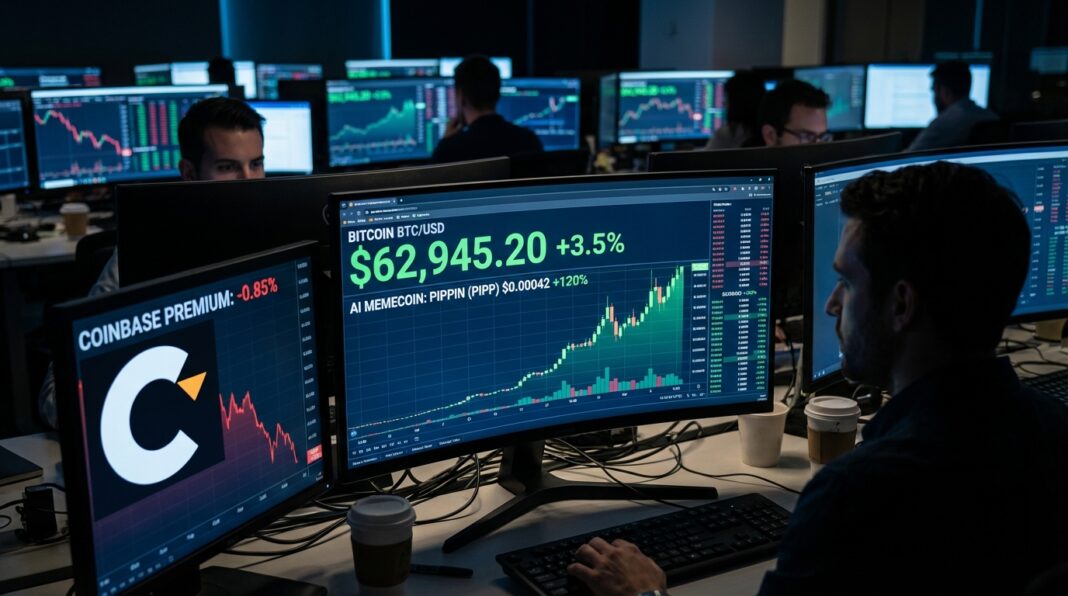

Bitcoin traded near $63,000, with prices recorded at about $63,304.16 amid persistent speculative froth across cryptocurrency markets. The cryptocurrency has fallen almost 50% since October, constituting a substantial decline in recent months. That speculative environment has been visible in rapid token rallies and elevated short-term trading activity, producing a broadly volatile market backdrop while avoiding detailed explanation of underlying mechanisms.
Pippin (PIPPIN) surged 135% over the past four weeks and rose about 10% in the last 24 hours, marking notable short-term gains in meme-token trading. The token was created by Yohei Nakajima and began as a ChatGPT-generated unicorn image before evolving into an autonomous AI agent on social media. LunarCrush says Pippin’s price action is driven by speculative interest and rapid market cap growth but raised concerns that manipulation and ‘crime’ may be involved.
“Pippin’s price action is currently driven by strong speculative interest and rapid market cap growth, but concerns about manipulation and ‘crime’ suggest that the current price may be influenced by artificial pumps rather than organic demand, creating a volatile environment.”
These developments occurred amid a broader volatile market backdrop.
Whatever the case, PIPPIN’s performance is evidence of lingering speculative froth in the market despite bitcoin dropping almost 50% since October. LunarCrush’s concerns underscore the possibility that artificial pumps have contributed to recent price volatility.
During Asian trading hours, Bitcoin’s price dipped below $63,000 but later stabilized near $63,200, indicating a marginal recovery. Alongside this, major cryptocurrencies such as Ethereum (ETH), Solana (SOL), and XRP also experienced similar declines. The CoinDesk 20 Index, which represents a benchmark for crypto performance, recorded a fall of 2% to 1816.14 points. The market movements are influenced by U.S. tariffs and growing concerns over AI-driven disruptions, which continue to weigh heavily on risk assets.
Within the CoinDesk 20 Index, specific tokens showed varied performance: ICP increased by 1.2%, NEAR decreased by 0.3%, Bitcoin Cash (BCH) dropped by 4.2%, and SUI fell by 2.5%. In contrast, Uniswap (UNI) rose by 0.5%, and AAVE demonstrated a notable increase of 1.7%. These changes reflect the complex dynamics of the crypto market amidst external pressures.
The Coinbase Premium Index has been negative for 40 consecutive days, with a current reading of -0.0467%, representing the longest streak of sub-zero readings since 2023 and indicating an extended period in which Coinbase has traded at a discount relative to Binance. The index measures the bitcoin price premium on Coinbase relative to Binance, comparing prices on those two exchanges to show whether Coinbase is trading at a premium or discount.
“The premium has now been negative for 40 consecutive days, according to Coinglass data, setting the longest streak of sub-zero readings since 2023.”
The previous record was roughly 30 days of continuous negative premium during the October 2025 drawdown. These points present the current status of the Coinbase Premium Index as a persistent negative reading over an extended span.
Adam Back’s BSTR project is moving forward with public listing plans, with hopes for approval by April. Back remains optimistic despite brutal price action in bitcoin and BTC treasury companies. The project continues its public-listing process amid the current market environment.
Markets remain volatile: bitcoin sat near $63,000 (about $63,304.16) and has fallen almost 50% since October, while speculative froth shows in tokens such as Pippin, which surged 135% over four weeks and about 10% in 24 hours. The CoinDesk 20 Index was down 2% to 1816.14, and the Coinbase Premium Index has been negative for 40 consecutive days at -0.0467%.