







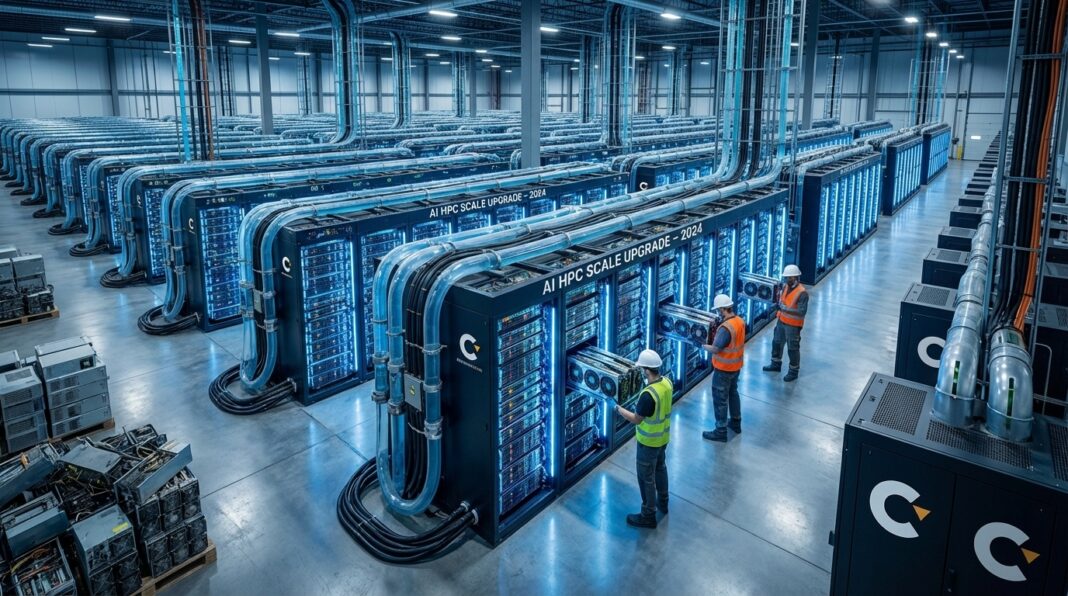

Bitcoin miners pivot to AI infrastructure as publicly listed miners faced a weighted average cash cost of about $79,995 per bitcoin in Q4 2025 while bitcoin traded around $68,000 to $70,000, creating an estimated loss of roughly $19,000 on each bitcoin mined. The strategic shift includes more than $70 billion in cumulative AI and high-performance computing contracts announced across the public mining sector.
Leading bitcoin miners have announced substantial AI and HPC contracts, underscoring their shift towards technology-centric operations. CoreWeave, in partnership with Core Scientific, has expanded a colossal $10.2 billion agreement spanning 12 years. TeraWulf boasts $12.8 billion in contracted high-performance computing revenue, highlighting a strategic pivot. Hut 8 has committed to a $7 billion, 15-year lease for AI infrastructure at its River Bend campus. Additionally, Cipher Digital has secured a multi-billion-dollar deal with Fluidstack. Reflecting this shift, AI revenue now constitutes 39% of Core Scientific’s total, 27% for TeraWulf, and 9% for IREN, with the latter developing up to 200 MW of liquid-cooled GPU capacity. These moves are pivotal for the mining industry’s evolving business landscape.
Capital and operational metrics differ sharply between bitcoin mining and AI infrastructure. Bitcoin mining infrastructure costs are approximately $700,000 to $1 million per megawatt, and miners require electricity costs below $0.05 per kilowatt-hour to remain cash-profitable. Hash price was roughly $28 to $30 per petahash per day in early March. These operational figures relate to cash-profitability thresholds reported for miners.
AI infrastructure contracts promise margins above 85% and multi-year revenue visibility. Publicly listed miners have announced over $70 billion in cumulative AI and high-performance computing contracts across the sector. IREN is developing up to 200 megawatts of liquid-cooled GPU capacity. IREN has $3.7 billion in convertible notes, and TeraWulf carries $5.7 billion in total debt. These reported financial and contract figures are presented alongside miner activity in AI and HPC.
The publicly listed bitcoin mining sector is shifting revenue toward AI infrastructure, converting mining operations and existing capacity into AI and high-performance computing services backed by large, multi-year contracts. This market-driven reorientation has materially altered companies’ business mixes and revenue composition, with AI-related income becoming a central and growing component of reported activities across the public mining sector. The shift reflects a broader strategic response across the sector.