







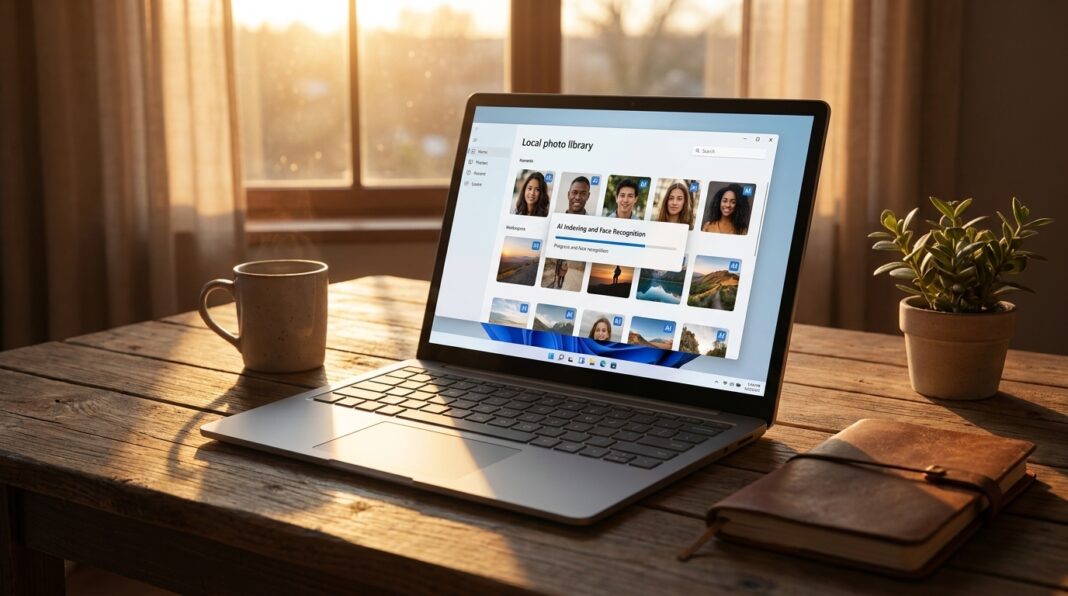

OneDrive Photos was quietly added to Windows by Microsoft and appears on systems via Windows Update or through updates to the existing OneDrive client rather than as a separate download. The app automatically indexes images stored locally and can detect and display local photos even when a user is not signed into a Microsoft account; after signing in it enables AI-powered search with natural-language queries and optical character recognition. The app also offers an optional facial grouping feature.
After signing in, OneDrive Photos enables AI-powered search that can locate photos using natural-language queries and optical character recognition, combining conversational query support with the ability to extract text from images. The app’s search features operate within OneDrive Photos once a user is authenticated and are designed to surface matching images through those AI capabilities. Separately, the app includes an optional People feature that groups similar faces into collections for the device user. Those grouped faces are visible only to the user, are not shared with third parties, and can be deleted by disabling the People feature. Because facial data may be considered biometric information in some jurisdictions, the People feature requires users to opt in before facial grouping is used. Users must explicitly opt in to enable People on their device.
OneDrive Photos is being distributed to Windows systems via Windows Update or through updates to the existing OneDrive client rather than as a separate download. The app is tied to the existing OneDrive client and cannot currently be removed on its own. Users who want to uninstall the app must remove OneDrive entirely from Windows. Because the app is delivered as part of OneDrive client updates, it does not appear as an independent installation option.
Two years after a privacy backlash over Microsoft’s AI-powered Recall feature, Microsoft overhauled Recall and made the screenshotting tool opt in by default. That historical change is cited as context for privacy discussions around new image- and AI-related features. In May, Google began downloading its roughly 4GB Gemini Nano AI model to eligible Chrome installations through browser updates to power on-device AI features. Microsoft did not immediately respond to a request for comment by Decrypt.
These distribution and privacy developments sit alongside industry moves to deploy on-device AI through updates rather than separate downloads. The record of Microsoft’s Recall overhaul and the noted non-response to Decrypt are part of the surrounding public record.
OneDrive Photos was quietly added to Windows and automatically indexes images stored on the device while offering AI-powered search and an optional People facial grouping feature that requires users to opt in, keeps grouped faces visible only to the user, is not shared with third parties, and can be deleted by disabling the feature.
The app is distributed via Windows Update or through updates to the existing OneDrive client rather than as a separate download, is tied to the OneDrive client so it cannot be uninstalled on its own, and its introduction follows a privacy backlash that prompted Microsoft to overhaul the Recall feature and make the screenshotting tool opt in by default; Microsoft did not immediately respond to a request for comment by Decrypt.