







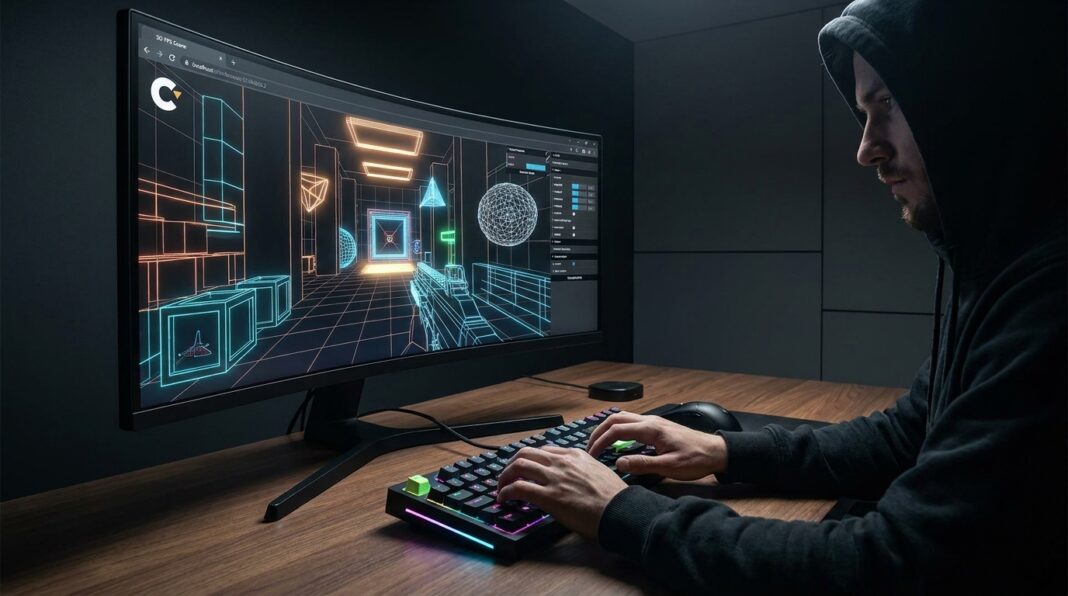

Gauntlet Loop prompt strategy: Claude Opus 5 built a fully playable first-person shooter.
Two days after Claude Opus 5 shipped, a demonstration showed the model had built a fully playable first-person shooter from a short prompt, a workflow described using the Gauntlet Loop prompt strategy. The finished build runs on Three.js and plain WebGL2 and comprises roughly 55,000 lines of code organized across 11 subsystems. All textures, meshes, animations, and sounds were generated inside the browser at load time, with no downloaded models, HDRIs, image files, or audio files used.
The first-person shooter created by Claude Opus 5 is an impressive demonstration of in-browser game generation. This game, developed using Three.js and WebGL2, is comprised of approximately 55,000 lines of code organized into 11 subsystems. What makes this project notable is that all assets, including textures, meshes, animations, and sounds, are generated directly within the browser at load time.
There are no external downloads such as models, HDRIs, images, or audio files, ensuring that everything is processed and rendered in real time. The initial prompt that resulted in this build was only three short paragraphs long and is accessible on GitHub, allowing others to explore the underlying instructions that guided the model’s development process.
This demonstration highlights the capabilities of Claude Opus 5 in handling complex tasks with minimal initial input.
Anthropic’s built-in /loop skill was used to enable repeated fix-test-adjust cycles during the build process. Ultracode, a Claude Code setting, let the model write its own orchestration plan and fan work across as many as 16 agents at once, capped at 1,000 per run. Gauntlet Loop involves handing an agent a real, inspectable bar instead of a vague instruction, splitting the job into pieces, and routing each piece through a critic that never sees the builder’s reasoning.
The prompt that produced the game ran three short paragraphs and was published in full on GitHub. These named techniques and settings are reported as part of the demonstration of how the game was generated by Claude Opus 5. The demonstration materials documented the use of /loop, Ultracode, and Gauntlet Loop in the build notes.
Matt Shumer maintained a critic log that shows the demo’s score climbing from 3.59 out of 10 toward just above 5. The critic log records the numeric score progression during the demo’s evaluation. Matt Shumer is named in connection with the demo’s performance evaluation and associated materials. The demonstration was described as ‘utterly perfect.’
Those recorded values and the quoted reaction form part of the documented reception of the demo. They appear in the materials reporting on the demonstration. These elements are part of the available documentation set, included.
Claude Opus 5 built a fully playable first-person shooter entirely within the browser, demonstrating an AI-driven approach to assembling game systems and in-browser assets.
The demonstration materials reference prompt engineering techniques such as the Gauntlet Loop prompt strategy and Anthropic’s /loop skill, and list Ultracode as a Claude Code setting used for agent orchestration.
The published materials include the three-paragraph prompt and evaluation artifacts, including a critic log maintained by Matt Shumer.