







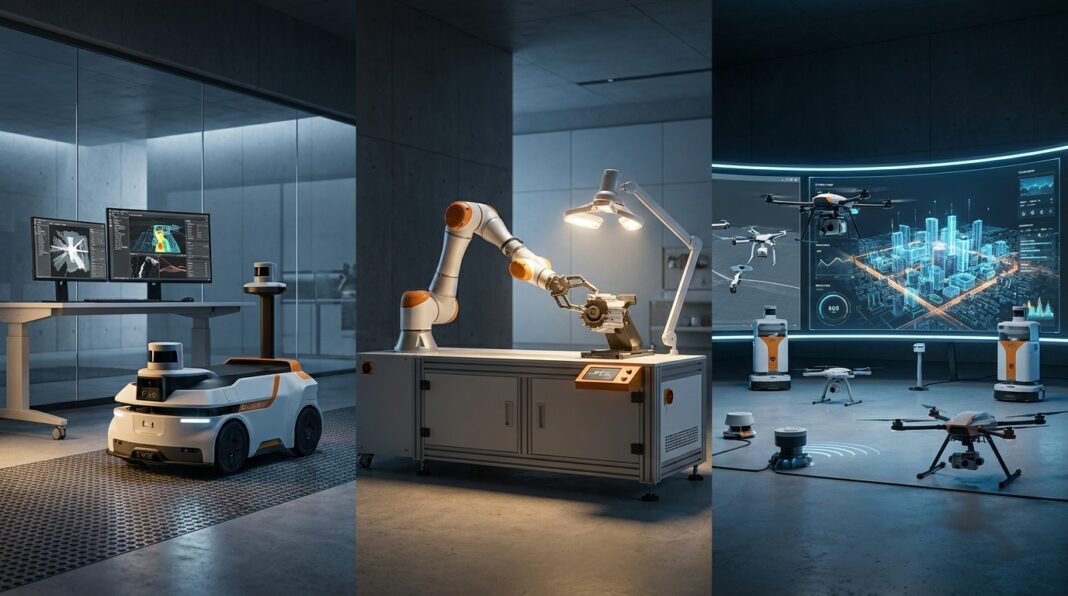

Alibaba has launched the Qwen-Robot Suite, a comprehensive set of three foundation models described as a “full stack for embodied intelligence.” This release marks Alibaba’s significant foray into the robotics ecosystem, positioning the company uniquely in China given its capabilities across chips, cloud, models, platforms, and applications.
Capabilities of Qwen-RobotNav within the Qwen-Robot Suite
Qwen-RobotNav, a pivotal component of the Qwen-Robot Suite, integrates five navigation tasks: instruction following, point-goal navigation, object search, target tracking, and autonomous driving. This model features a parameterized interface that allows for dynamic reconfiguration mid-episode. Key parameters such as token budget, temporal decay, and per-camera weights can be adjusted to optimize performance in real-time.
The model’s robustness is further demonstrated by its training on 15.6 million samples, involving comprehensive parameter randomization to enhance learning efficacy. Notably, Qwen-RobotNav achieves significant benchmark results: a 76.5% success rate on the VLN-CE RxR benchmark, and a 90% accuracy rate in tracking tasks on the EVT-Bench benchmark. This foundation model exemplifies a sophisticated approach to embodied intelligence, distinguishing itself as a leader in robotic navigation.
Qwen-Robot Suite: Qwen-RobotManip features and performance
Qwen-RobotManip bridges incompatible action spaces across different robot types by translating between the distinct control representations used by each platform. The model accommodates Franka arm controls expressed as joint angles, ALOHA robot controls expressed as end-effector poses, and humanoid controls expressed in whole-body coordinates. Training for Qwen-RobotManip used approximately 38,100 hours of synthesized data derived from open-source robot datasets and human videos. In benchmark evaluation, Qwen-RobotManip ranked first on RoboChallenge Table30-v1, outperforming previous approaches by 20%.
These technical details relate specifically to Qwen-RobotManip within the Qwen-Robot Suite. They describe the model’s handling of heterogeneous robot control representations and the scale of its synthesized training data. They also report the model’s top ranking on the RoboChallenge Table30-v1 benchmark relative to prior approaches.
The Qwen-Robot Suite is described as “the operating system for the robot economy” and an “Android moment for robotics.” Those descriptions present the suite as software foundational to robotics beyond hardware. The release materials explicitly characterize the offering as “the operating system, not the hardware,” and describe the suite as three foundation models forming a “full stack for embodied intelligence.” The materials also state that Alibaba is the only company in China spanning chips, cloud, models, serving platforms, and applications.
These characterizations are presented in the Qwen-Robot Suite materials. They frame the suite as a software layer distinct from hardware.