






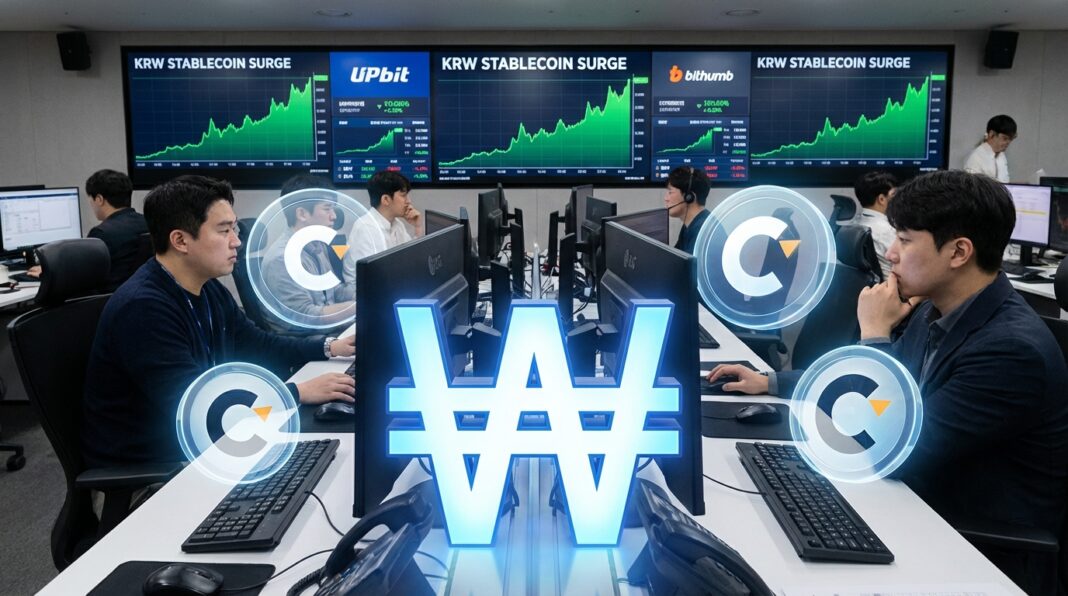

Stablecoin trading activity in South Korea has risen sharply as the won weakened against the U.S. dollar. During the period when the USD/KRW exchange rate climbed above 1,480 won per dollar, stablecoin trading volume surged by 62%. USDT trading across five major won-based exchanges—Korbit, Coinone, Upbit, and Bithumb—reached 378.2 billion won, reflecting heightened demand for dollar-linked digital assets amid currency pressure.
The currency backdrop has been marked by sustained weakness in the won. The won recorded a nine-day losing streak against the dollar, its longest downturn since 2008. Exchange-rate levels during this period included a move above 1,480 won per dollar, a subsequent reading of 1,467.7, and a closing level of 1,471.3 following official remarks. On a year-to-date basis, the won has declined by nearly 2%, underscoring broader depreciation pressures.
Alongside exchange activity, South Korea’s major cryptocurrency platforms introduced promotional campaigns tied to stablecoins. Exchanges including Korbit, Coinone, Upbit, and Bithumb launched initiatives that featured waived trading fees and reward distributions linked to stablecoin usage. These campaigns coincided with the rise in trading volumes and were positioned to attract participation during a period of elevated currency volatility.
Shifts were also observed in banking flows as dollar-denominated deposits declined. As of January 22, dollar deposit balances at five major banks fell by 3.8% to $63.25 billion. Corporate dollar deposits decreased from $52.42 billion to $49.83 billion, while individual dollar deposits increased by $109.64 million, a much smaller rise compared with a $1.09 billion surge recorded in the prior month. These movements suggest changes in how both firms and households positioned their foreign-currency holdings.
Banks adjusted dollar-deposit rates in response to these conditions. Shinhan Bank reduced its dollar-deposit annual rate from 1.5% to 0.1%, effective January 30, while Hana Bank lowered the rate on its Travelog Foreign Currency Account from 2% to 0.05%. Shinhan Bank also introduced incentives aimed at encouraging conversion back into won, offering a 90% preferential rate for customers converting dollar deposits and a 0.1 percentage-point boost for won-term deposits.
Broader macroeconomic indicators during the same period pointed to slowing momentum. Fourth-quarter gross domestic product growth eased to 1.5% year over year, construction investment declined by 3.9%, and exports fell by 2.1% compared with the previous quarter. At the same time, South Korean retail investors increased their exposure to U.S. equities, purchasing about $2.4 billion worth by mid-January, representing an increase of roughly 60% year over year.
Regulatory and legislative developments have added another layer to the evolving financial landscape. South Korea lifted a nine-year ban on corporate cryptocurrency trading, allowing listed companies to invest up to 5% of their equity in the top 20 cryptocurrencies by market capitalization. Amendments to the Capital Markets Act and the Electronic Securities Act are establishing a legal framework for tokenized securities, with implementation targeted for 2027. However, progress on broader digital asset legislation, particularly around stablecoin issuance, remains stalled due to disagreements between the Financial Services Commission and the Bank of Korea.
In parallel, Jeong Eun-bo, chairman of the Korea Exchange, has pledged to advance digital asset offerings by pursuing the launch of spot Bitcoin exchange-traded funds and extending trading hours to a 24/7 schedule. These initiatives signal a strategic effort to align South Korea’s financial markets with global digital asset standards while balancing regulatory oversight.
Conclusion
The recent surge in stablecoin trading in South Korea reflects a convergence of currency depreciation, shifting investor behavior, and evolving regulatory frameworks. As the won weakened, demand for dollar-linked digital assets intensified, accompanied by changes in exchange activity, bank deposit flows, and promotional strategies. At the same time, legal reforms and market initiatives point toward a gradual integration of digital assets into the broader financial system, even as key regulatory questions around stablecoins remain unresolved.